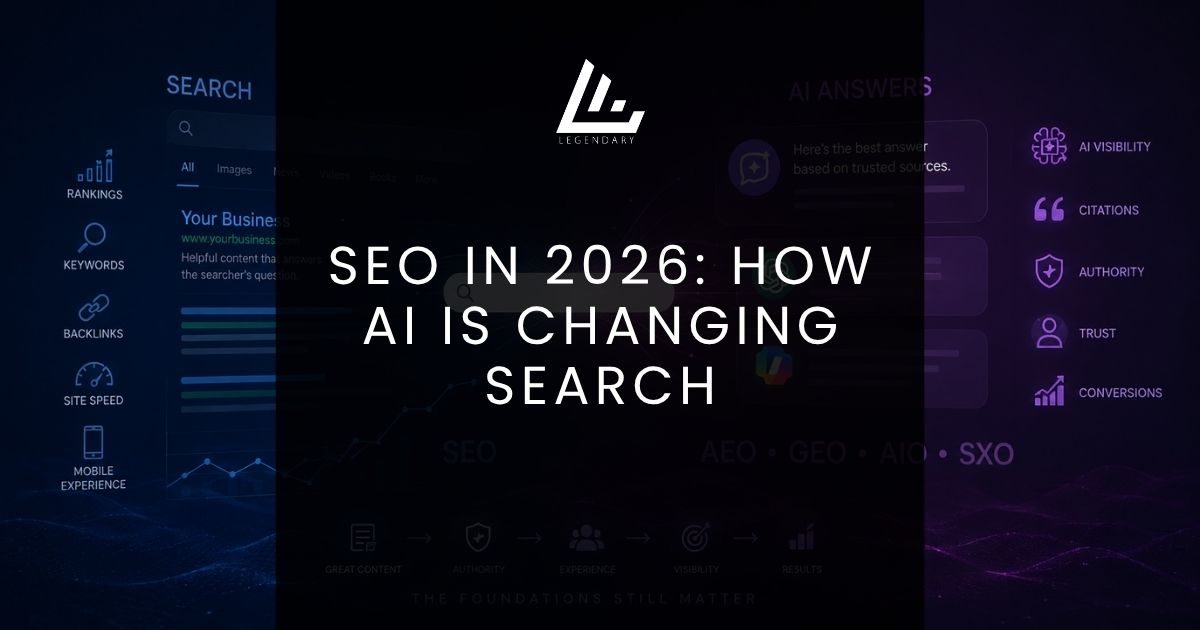
SEO in 2026: How AI Is Changing Search
If you’ve spent any time reading about SEO lately, you’ve probably noticed there are suddenly a lot more acronyms being thrown around.
SEO. AEO. GEO. AIO. SXO.
Then we add AI Overviews, ChatGPT, Copilot and other AI-powered search tools into the mix, and it can start to feel like everything we knew about search has changed overnight.
The good news is that it hasn’t.
SEO in 2026 is changing, but many of the fundamentals that have always helped businesses get found online still matter.
What’s really changing is where and how people search.
People aren’t only typing something into Google and clicking through a list of websites anymore. They’re asking questions through traditional search engines, AI-powered search results and conversational AI platforms.
For businesses, that means we need to think beyond simply ranking.
We want our businesses to be found, understood, cited, trusted and ultimately chosen.
Let’s break down what that actually means.
What Does SEO in 2026 Look Like?
Traditional search isn’t disappearing.
Google still processes searches. Bing still matters. People are still visiting websites, reading articles, comparing businesses and researching products and services.
At the same time, AI has added new ways for people to find information.
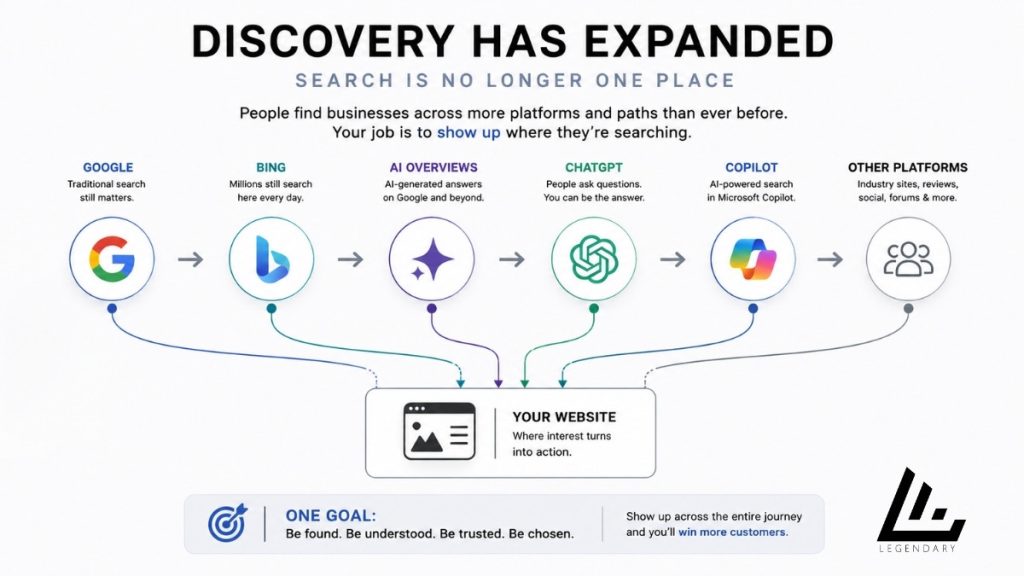
Someone looking for a business like yours might:
- Find your website through Google
- See your business or content referenced in an AI Overview
- Ask ChatGPT about companies that provide your service
- Search through Bing or Microsoft Copilot
- Discover your company through another trusted website
- Read reviews or recommendations before ever visiting your website
- Visit your site after researching their problem somewhere else
That’s why I think it’s helpful to look at search as a journey, rather than one results page.
A business might be highly visible in one part of that journey and almost invisible in another.
The opportunity in 2026 is to understand where your customers are searching and make sure your business has a strong presence across the places that actually matter to them.
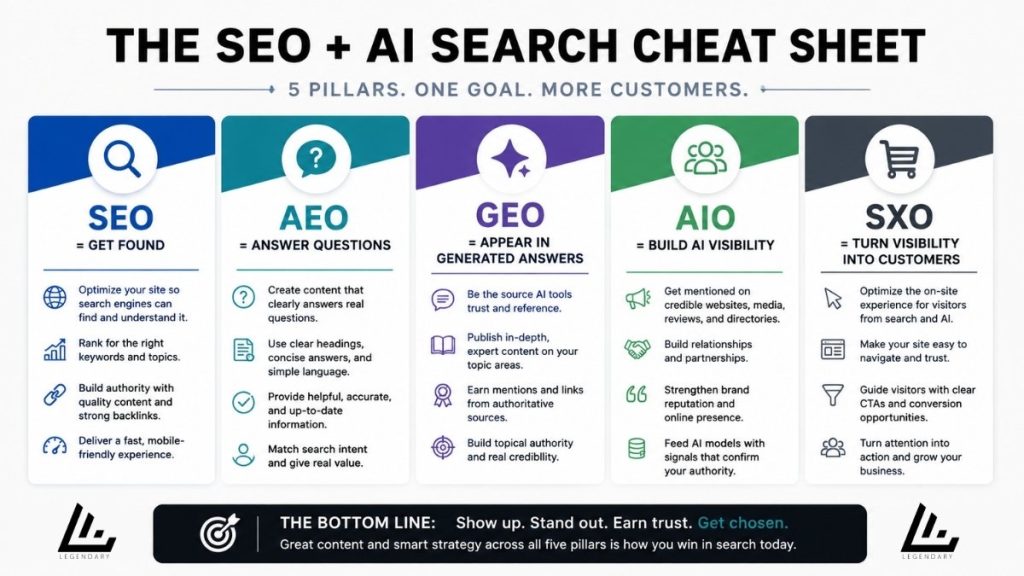
SEO: Search Engine Optimization
Let’s start with the one most of us already know.
SEO in 2026 is still an important foundation.
SEO helps search engines discover, understand and rank the content on your website.
That still includes things like:
- Helpful, original content
- Understanding search intent
- Relevant keywords
- Clear page titles and headings
- Internal linking
- Quality backlinks
- Crawlability and indexing
- Website speed and usability
- Mobile experience
- Accurate business information
- Authority and trust
Those things haven’t suddenly stopped mattering because AI entered the picture.
In fact, strong SEO can also support visibility in AI-powered search experiences because many of the same signals that make content useful to search engines also make it easier to discover, understand and reference.
So no, SEO isn’t disappearing.
It’s evolving.
And for businesses, that means building on the foundation rather than throwing it away.
AEO: Answer Engine Optimization
AEO stands for Answer Engine Optimization.
The basic idea is pretty straightforward.
Create content that clearly answers the questions people are asking.
A lot of good AEO looks very similar to good SEO because both start with understanding what someone is looking for and giving them useful information.
That means:
- Answering the actual question
- Making important answers easy to find
- Using clear, descriptive headings
- Explaining things in plain English
- Supporting important claims
- Structuring longer content logically
- Keeping information accurate and current
Here’s a simple example.
Someone searches:
“How much should a small business spend on Google Ads?”
They probably don’t want to read six paragraphs before getting any useful information.
Give them an answer.
Then explain the variables, provide context and help them understand what might make sense for their particular business.
That’s better for the person reading the page.
It’s also clearer for search engines and AI systems trying to understand what the page is about.
Good AEO doesn’t mean writing for robots.
It means making your content easier for everyone to understand.
GEO: Generative Engine Optimization
GEO stands for Generative Engine Optimization.
This is where we’re specifically thinking about visibility inside AI-generated answers.
Traditionally, businesses have asked questions like:
“Where do we rank on Google?”
That’s still a useful question.
But now we should also be asking:
“Does our business appear when AI answers questions about our industry, products or services?”
That’s a different kind of visibility.
For example, someone might ask an AI platform:
“What should I look for when hiring a digital marketing company?”
or:
“What are some marketing agencies in Winnipeg that work with small businesses?”
The user may get an answer without seeing a traditional page of ten blue links first.
That means businesses should start paying attention to whether their brands, websites and expertise are appearing within those answers.
Microsoft has already started moving in this direction. Bing Webmaster Tools now provides AI performance information that can help website owners understand when their content is being cited in AI-generated experiences.
Rankings still matter.
Traffic still matters.
But AI visibility and citations are becoming another part of the picture.
AIO: AI Optimization
You’ll also see the term AI Optimization, or AIO.
The terminology around AI search is still evolving, so I wouldn’t get too caught up in memorising every acronym.
What’s more useful is understanding the idea behind it.
One part of AI visibility that businesses sometimes overlook is what happens outside their own website.
Your website is where you control the story about your business.
But the rest of the web helps establish your reputation.
That can include:
- Industry publications
- News coverage
- Associations
- Business partners
- Customer reviews
- Interviews
- Podcasts
- Directories
- Expert roundups
- Mentions and links from other credible websites
If trusted sources are talking about your business, linking to your content, reviewing your company or recognizing your expertise, that creates additional signals about who you are and what you’re known for.
This isn’t really a brand-new concept.
Businesses have been building reputations through PR, partnerships, reviews, media coverage and links for decades.
AI search simply gives us another reason to think about how our businesses are represented across the wider web.
Your website is important.
But your overall digital reputation matters too.
SXO: Search Experience Optimization
SXO stands for Search Experience Optimization, and this is one I think every business should pay attention to.
Because getting found is only the beginning.
Imagine someone finds your business through Google.
Or maybe ChatGPT mentions you.
Maybe they see your company in an AI-generated answer and decide to check you out.
They click through to your website.
What happens next?
Can they immediately understand what you do?
Does your website look professional and credible?
Can they easily find the information they’re looking for?
Does it work properly on their phone?
Is there an obvious next step?
Can they contact you without hunting for a form or phone number?
And most importantly, does your website give them a reason to choose you?
That’s where SXO comes in.
It’s about turning visibility into opportunity.
You can have fantastic rankings and plenty of traffic, but if your website doesn’t build trust or encourage people to take the next step, that visibility isn’t doing nearly as much for your business as it could.
That’s why I don’t think SEO, website design, content and conversion strategy should be treated as completely separate things.
They all contribute to the same journey.
Get the Foundations Right, Then Adapt
With so much changing in search, it’s easy to feel like you need to do everything at once.
You don’t.
Start with the fundamentals and build from there.
For most businesses, I’d focus on these areas:
- Create genuinely useful content.
Answer the questions your customers actually ask and give them information they can use. - Build expertise around the topics that matter to your business.
One article can be helpful. A consistent library of useful content gives people, search engines and AI systems a much clearer picture of what you know. - Keep your technical SEO healthy.
Your website still needs to be crawlable, indexable, fast and easy to use. - Make your content easy to understand.
Clear headings, direct answers and logical structure make content better for people and easier for search systems to interpret. - Build authority beyond your own website.
Earn legitimate reviews, mentions, links, partnerships and coverage from credible sources. - Keep your information current.
Review older pages and articles periodically. Update things when your industry, services or the information itself changes. - Measure more than rankings.
Organic rankings are still useful, but also pay attention to traffic, leads, conversions, branded searches and AI visibility where reliable data is available. - Make sure your website can turn attention into action.
Once someone finds you, make their next step easy.
None of this requires abandoning SEO.
It requires expanding how we think about search.
What About Schema, llms.txt and Other AI SEO Tactics?
Whenever search changes, new tactics and tools appear alongside it.
Some become important.
Some have specific uses.
Some are still experimental.
Structured data, often referred to as schema, still has legitimate SEO uses. It can help search engines understand certain information on a page and can make eligible content available for specific search features.
What businesses should understand is that Google does not currently require special AI-specific schema markup to appear in its AI search features.
You’ll also hear more about files such as llms.txt, which have been proposed as a way for websites to provide information to large language models.
It’s an interesting idea, but it shouldn’t take priority over proven fundamentals.
If you’re deciding where to spend your time, I’d fix outdated content, poor service pages, technical problems, weak internal linking and a confusing website experience before worrying about experimental additions.
There’s nothing wrong with watching new technology develop.
Just make sure the basics are working first.
SEO Isn’t Dead. Search Is Getting Bigger.
That’s really the story of SEO in 2026.
Google matters.
Bing matters.
Your website matters.
AI-powered search matters.
ChatGPT, Copilot and other AI platforms are becoming another part of how people research businesses, products and services.
As that continues, the lines between SEO, content, PR, reputation, website experience and conversion are becoming more connected.
For businesses, I think the goal can be summed up pretty simply.
Be easy to find.
Be easy to understand.
Be easy to trust.
Be easy to choose.
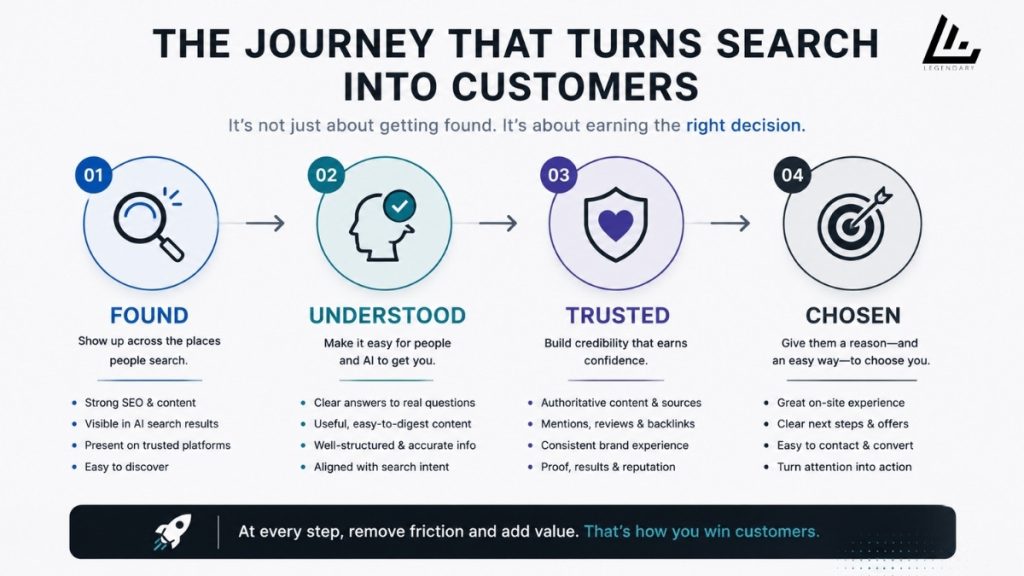
That’s where search is heading.
And when you strip away all the new terminology, those are pretty good marketing principles anyway.
Is Your Business Ready for Search in 2026?
Search is changing quickly, and keeping up with it can feel like a lot.
The good news is that you don’t need to rebuild your entire marketing strategy every time something changes.
You need to understand what has changed, what actually matters to your business and where the best opportunities are.
That’s something we can help with.
At Legendary, we work with businesses on SEO, content, websites, digital marketing, branding, automation and the bigger strategy that connects all of it.
You can learn more about what we do and see some of the businesses we’ve worked with.
And if you’re wondering how your business is showing up in search today, or what you should be doing to prepare for where search is going next, get in touch with us.
We’ll take a look at where you’re at, talk about where you want to go and help you figure out the smartest way to get there.
Because the goal isn’t to collect more acronyms.
It’s to get your business found by the right people and turn more of those people into customers.